Showing posts with label Mantra. Show all posts

20 July 2011

Article on Mantra

3quarksdaily has published an article on mantra. (thanks Bodhipakṣa from Wildmind for the tip):

The Hallucinogenic Meaning of Mantras.
by Hartosh Singh Bal

The article is a bit light on conclusions, but gives nods to the research of Steve Farmer and Michael Witzel on the Indus Valley script. It also quotes Frits Staal who has written a lot about mantra, though I would not endorse most of it.

What conclusions there are, are based on the idea that Soma was a hallucinogen. Though I do not think there is any consensus on what Soma was (it has since been lost and replaced by another plant) it seems to me that the most likely candidate is ephedra which has ephedrine as an active ingredient. Ephedrine is a stimulant rather than a hallucinogen. In his documentary "India" Michael Wood seeks out and takes Ephedra tea in a market in Peshawar and describes the effects on camera: a feeling of energy, heightened senses, and talkativeness.

17 July 2011

BBC Radio program on Sacred Sounds

The Power of Oṃ. BBC Radio 4 documentary on mantra. Might only be available in the UK.
"Reverend Richard Coles explores the world of spiritual sound and meditation and tries to understand what it is about certain sounds and chants which gives practitioners a sense of proximity to the Divine."

25 February 2010

Tibetan Cymbal Symbols

A friend recently wrote to me:
Please could you tell me what my cymbals say?

I've been taking these cymbals into prison for over 15 years, to ding meditation stages. Occasionally, someone asks me what the symbols mean. I confidently reply that it is the Avalokiteshvara mantra.

Only, last week a bright spark asked if it says "om mani padme hum" how come there are seven symbols rather than six?
The answer is quite simple. It is the Avalokiteśvara mantra written in a Tibetan script called dbu-can (pronounced uchen) - the main formal script they use for texts and printing. The extra symbol is a paragraph marker, known as a 'shed' in Tibetan. It's more often a simple vertical stroke, but sometimes a colon-like thing as you have here.

oṃ ma ṇi pad me hūṃ :

I've added the letters onto your image so you can see which is which. While we're on the subject there is no word break in maṇipadme - it is a single compound word meaning, most likely "in the jewelled lotus" (but clearly not "the jewel in the lotus" as Sanskrit grammar does not allow this meaning, despite it's popularity). I've written about this on my blog post "The Meaning of oṃ maṇipadme hūṃ".

Note the Tibetans write "pa dme" as "pad me" because it looks more Tibetan. In the image below the top line is what is on your bells, and the bottom line is the proper Sanskrit, but still using the same script.


One also sees the mantra on these kinds of bells written in the Lantsa script (below).


My compliments to the bright spark who spotted that there were seven symbols!

17 December 2009

Offering Mantra


Gino recently asked about the offering mantra used during the maṇḍala offering practice. I thought other people might be interested in this as well.

The mantra reads:

idaṃ guru-ratna-maṇḍalakaṃ niryātayāmi
इदं गुरुरत्नमण्डलकं निर्यातयामि
(above in dbu-can)

If we take this to be a Sanskrit sentence then the words guru and ratna are undeclined suggesting that they are part of a compound: gururatnamaṇḍalakaṃ. So how should be parse this compound? Firstly the individual words: guru = teacher; ratna = jewel; maṇḍalaka is a variant of maṇḍala. The -ṃ ending would appear to match the idaṃ and be an accusative making idaṃ gururatnamaṇḍalakaṃ the object of the verb. I suggest that we take ratnamaṇḍalaka to be a tatpuruṣa - maṇḍala of jewels. Then it would make some sense for this to make a tatpuruṣa with 'guru', but perhaps of the dative kind, 'to or for the guru' rather than the standard genitive 'of the guru'. Looking at the context I think this fits what is being done in practice.

The verb comes from the root √yat 'to stretch'. What we have here is a causative form: yātayati which can mean 'to suffer', or in this case 'to yield up' or 'surrender'. The first person singular is yātayāmi 'I surrender'. The addition of the prefix nir- here indicates that one is giving up to others. Of Monier-Williams' suggestions 'to give back, to restore' seem to fit the context, he notes the sense of 'to give as a present' in the Lalitavistara Sūtra.

So we could render the phrase

idaṃ guru-ratna-maṇḍalakaṃ niryātayāmi
I offer up this jewel-maṇḍala to the guru

31 August 2009

New Mantra

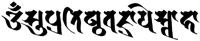
Caught up with Tashi Mannox on a recent visit to London which was cool. He gave me a calligraphy of a mantra I hadn't come across before. It is used in the conclusion of Tibetan sadhanas.

oṃ supratiṣṭhavajraye svāhā

So after doing some research and consulting him about the Tibetan writing and pronunciation I've added the first new page to visiblemantra.org for some time. I'm calling it the supratiṣṭha mantra for want of a better name. The page has Siddhaṃ, Uchen and Devanāgarī.

08 September 2008

Mystery Mantra

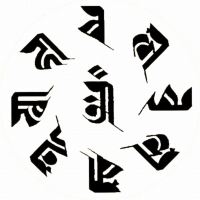
A couple of days ago I noticed a mystery mantra on Omniglot's Puzzles Page. I couldn't see well enough to read so wrote and asked Mitchell who'd posted it to send a better quality image. He sent me the image on the left and things became more clear.

The script is obviously Lantsa. I know some Lantsa and there are one or two Lantsa resources on the web (see the scripts page) but I'm not very confident in it yet.

The centre syllable is obviously oṃ. From 12 o'clock I read ca le cu le co nde svā hā.

So the mantra is: oṃ cale cuale conde svāhā.

However this is not a mantra I am familiar with, nor can I find it in any of my usual sources. If you know this mantra please let me know.

Update: 18-9-08 and 3-11-08

Thanks to Fuxi who wrote in to suggest that this mantra may be related to Zhunti. If you look at Mediation Expert you can see the same diagram on a page of the sadhana instruction. In Sanskrit the name is Cundī, meaning "pure" and she is a feminine form of Avalokiteśvara, or perhaps a form of Uṣas or Mārīcī. In the Mahācundi Dhāraṇī there is a mantra: namo saptanam samyaksambuddha kotinam tadyatha: oṃ cale cule cundi svaha. The mantra above could be a form of this.

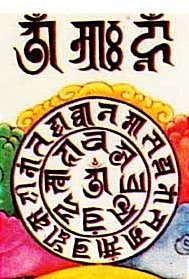
If you look at the image on the left, which is a close-up of a Cundi image, you can see some Sinified Lantsa script.

Across the top in larger letters is: oṃ āḥ hūṃ

Around the outer circle of the image reads: namo saptanam samyaksambuddha kotinam tadyatha. It starts just to the right of 12 o'clock.

The centre of the circle matches the image originally sent to Omniglot by Mitchell, with oṃ at the very centre. Ca is distinguished by a point on the loop - so with some hindsight we can see that the character could be ca. On the 3rd character what I took to be an 'r' ligature could be a 'u' diacritic though this usually is more curved and doesn't terminate on the stem. So the mantra above should be read:
oṃ cale cule cunde svāhā.