Showing posts with label Siddhaṃ. Show all posts

25 January 2014

Siddhaṃ and Maṅgala = Success and Luck.

As we know, after a certain period Buddhist manuscripts begin with the word siddhaṃ. It is this practice which lead to the script that developed after the Gupta Empire to be called Siddhaṃ or Siddhamātra. In Patañjali's Vyākaraṇamahābhāṣya (Great Commentary on Grammar) composed about 150 BCE, he says explains why this word was emphasised:
maṅgalārtham . māṅgalikaḥ ācāryaḥ mahataḥ śāstraughasya maṅgalārtham siddhaśabdam āditaḥ prayuṅkte . maṅgalādīni hi śāstrāṇi prathante vīrapuruṣakāṇi ca bhavanti āyuṣmatpuruṣakāṇi ca . adhyetāraḥ ca siddhārthāḥ yathā syuḥ iti . (I.6.26 - 7.2)
For the sake of good luck (maṅgala). A superstitious (māṅgalika) teacher begins his great, extensive treatise with the word "siddhaṁ" to bring good luck. For treatises with a lucky beginnings spread (far and wide) and produce men who are heroic (vīra) and long lived (āyusmat). And those who study [that treatise] will accordingly achieve their goals (siddhārtha). 
In a Buddhist context the Buddha is said to have been critical of those who were māṅgalika, but was not beyond making accommodations with the customs of superstitious lay people. See my essay Gesundheit! Making Accommodations with Custom.

03 July 2011

Lakṣmī


siddhaṃlantsadbu-can
A friend wrote today to ask about the way to write the name of the goddess of good fortune Lakṣmī. This is traditionally done in Tibet as a bīja or single stack of letters (ignoring the a in la) in both dbu-can and Lantsa scripts. My version of this are on the left in three scripts.

An interesting thing about Lakṣmī is that she is not a Vedic goddess, i.e. doesn't appear in the Ṛgveda. She does appear - under the name Sirimā or Śrī - in the Pāli Canon (Rhys Davids Buddhist India, p.216-9). So she seems to have been a local goddess in North-East India that was adopted into both Buddhism and Hinduism. She puts in an appearance as Lakṣmī in the Golden Light Sūtra. Note that Wikipedia doesn't mention either her origins or her Buddhist associations. I have written on my other blog about how the Buddha describes village people as maṅgalika or superstitious, i.e. concerned with omens and luck (see: Gesundheit! Making Accommodations with Custom).

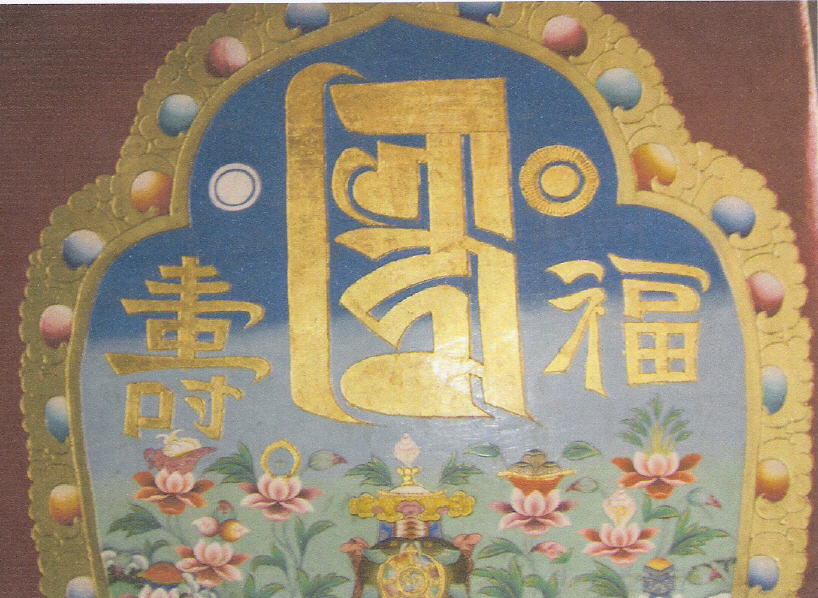
One also sees this written in Lantsa with a long ā and short i - i.e. लाक्ष्मि - this is common, though I think it is certainly an error. For example there is this image of the corrupt version with two hanzi: 壽 & 福 (Shòu & fú) literally 'life' and 'blessing'. More calligraphy of this version can be found on the East Wind Gallery site.

One sees the problem of mixed up vowel lengths a lot in Chinese and Japanese Siddhaṃ - for example the bīja dhīḥ is routinely written as dhiḥ (with a short i) in Japan. John Stevens says, in regard to other spelling errors that: "rightly or wrongly they have become part of the tradition." (Sacred Calligraphy, p.33). Personally I'm inclined to correct them as I say here and here.

For another (and much better) image of Lakṣmī's bīja written correctly see George Fisher's Indian Scripts website (the link is to a pdf, scroll down, Lakṣmī is the last bīja). The main website is www.lantsha-vartu.org.

11 May 2011

Siddhir astu

Since we have builders in the house and it's hard to concentrate here, I spent part of yesterday rummaging around the Cambridge University Library. I was looking for some articles on the symbols at the beginning of mantras. I plan a full scale blog post on that subject, but it's not ready yet. I did come across several references to this Sanskrit phrase: siddhir astu. Intriguingly when I began to look on the Internet I found it in several places, not only on Buddhist sites, but on Hindu sites as well where it is apparently a Ganeṣa mantra. The phrase, even when used as a mantra, is often incorrectly written as siddhi rastu.

Just to clarify there is no word rastu (in Sanskrit). The word is astu, which is the 3rd person singular imperative of the verb √as 'to be' and means 'may there be, may it be'. This leaves us with siddhir, which we can see is the word siddhiḥ (nominative singular) meaning 'accomplishment, perfection'. It is affected by the sandhi rule that -iḥ followed by a vowel becomes -ir: hence siddhir astu 'may there be perfection'. Note that when we transliterate Sanskrit in Roman script we break the word between the consonant and the vowel. However in Devanāgarī the situation is more confusing because the whole thing is written as one word - the r and a are combined into a single akṣara : सिद्धिरस्तु the syllables being सि द्धि र स्तु (si ddhi ra stu). This is one of the disadvantages of Indic scripts, and part of what makes learning Sanskrit difficult. To read it you have to know the suffixes and sandhi rules very well.

This kind of mistake is quite common amongst Buddhists, i.e. the mistake of seeing a familiar word like siddhi, and breaking there, even when it produces non-sense words like rastu. It seems to have happened in Tibetan readings of the Vajrasattva mantra from the Sarvatathāgata-tattvasaṃgraha as well - as I discuss in my Western Buddhist Review article on the mantra: The Hundred Syllable Vajrasattva Mantra. The best example is the phrase sarvakarmasu ca me cittaṃ sreya kuru' and, in all actions make my mind more excellent' being read as sarva karma suca me cittaṃ śreya kuru, thereby obliterating the sense of the words, leaving words without any grammatical relationships, and creating the nonsense word suca. Basically it's what happens when you have a tradition in a language you don't speak.

This does not explain the form found on page 33 of John Stevens' Sacred Calligraphy of the East: siddhāṃrastu (which I have commented on before). But at least we can now see where it comes from. What was written on ancient Sanskrit manuscripts was not siddhāṃastu, or even siddhamastu, but siddhir astu.


siddhirastu


Reference:
Roth, Gustav. (1986) 'Mangala-symbols in Buddhist Sanskrit Manuscripts and Inscriptions' in Bhattacharya, G (ed.) Deyadharma : Studies in Memory of Dr D. C. Sircar. Sri Satguru Pubs. Delhi, p. 239-250.

24 August 2010

Missing Websites

The Mật Tông Vietnamese Esoteric Buddhism - website (mattong.wordpress.com) seems to have disappeared which is a shame. Although the main language was Vietnamese there were some very fine examples of Siddhaṃ and Lantsa caligraphy on the site.

Also the SiddhaṃKey site seems to have shrunk to almost nothing as well with only the front page and an image of the word Siddhaṃ left. I never used their Siddhaṃ keyboard as I don't like the CBETA font, but I did find the Lantsa keyboard useful.

cont...
I've been in touch with Khai who created both of these sites and he just says he removed them "for personal reasons". There is a possibility of having new sites so, hopefully

I've uploaded the CBETA Siddham font to my site. You can download it from there. It has some limitations and I don't personally use it, but it would be a shame if it disappeared completely. I note it has been used extensively on the Wikipedia Siddhaṃ page.

28 May 2010

A common question

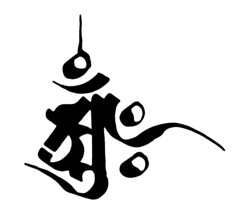
āṃḥ Buddhist TattooI've lost count of the number of times I've been asked about one particular bīja or akṣara. In Roman it is: āṃḥ. It seems that one particular version of this has captured the imagination of people browsing the web (see left). I'm not clear where the original came from, but it may be attributable to tattoo artist Andy Shou.

In my opinion this letter is not particularly well done, the lines are somewhat skewed - it is probably a design rather than calligraphy and therefore lacks the proper proportions and the connectedness that comes from a practised hand.

I have some basic info on this figure on my letter 'a' page.

The story is that in the Mahāvairocana Abhisaṃbodhi Tantra, one of two centrally important Tantric Texts for the Japanese Shingon School of Buddhism, the four basic variations on the letter a (ie a ā aṃ aḥ) are linked to the four stages of practice: bodhi, carya, saṃbodhi, nirvaṇa. The combined elements of all four letters give the figure in question and represent the culmination of Buddhist practice. It also stands for Mahāvairocana, the Dharmakāya Buddha as he appears in the Garbhadhātu Maṇḍala.

I've done a fresh calligraphy in my current style for this blog entry.

28 April 2010

evaṃ

evaṃ bīja padaLast year Tashi Mannox featured the word evaṃ on his calligraphy blog. His calligraphy is always attractive and adept, but I was fascinated by this particular character. Buddhists will know that one of the identifying marks of a sutta/sūtra is that it begins: evaṃ me sutaṃ/evaṃ mayā śrutaṃ. Tantras also begin with this phrase. The word evaṃ means 'so, thus, in this way'. The phrase is a passive construction, literally "thus / by me / it was heard", and attempts by contemporary scholars to override the Victorian rendering "thus have I heard" have not yet succeeded in dislodging it from the English speaking Buddhist psyche.

evaṃ bījaHowever in the Hevajra Tantra (ca. late 8th century) this first word takes on esoteric significance. I think this is largely related to the shape of the Siddhaṃ script letter 'e' which is an inverted triangle which in the Hevajra becomes a yoni symbol - i.e. because it looks like the female pudenda it represents the feminine principle. To my eye vaṃ is not particularly phallic, but it comes to represent the masculine principle. Perhaps the most significant correspondence is that of wisdom and compassion. So evaṃ, by combining the two principles, symbolises the union of opposites which is one of the ways in which the Buddhist goal is conceived of in Tantric Buddhism. This is my understanding, though Tashi has more information on his website.
For some time I have pondered how to represent this in the Siddhaṃ script, and I think I have finally found a way of doing it which is aesthetically pleasing.

image top-left: from the top - evaṃ bīja; evaṃ in Siddhaṃ, Lantsa, Tibetan, Devanāgarī.
image right: evaṃ bīja