Showing posts with label Tibetan. Show all posts

26 July 2011

Mystery Calligraphy

A friend sent me this image of some calligraphy obtained in Nepal asking what it says.

It looks like dbu me or one of the other headless scripts. I'd guess it says:

shes bya ཤེས་བྱ་
"object of knowledge"

c.f. the THL Dictionary definition.

When I searched for shes bya I found this book, and the image on the book jacket appears to confirm my suspicions: c.f. the first characters of this book jacket.


Am I correct?

12 July 2011

evaṃ

evaṃ calligraphyFor a long time I've been intrigued by Tashi Mannox's calligraphy of the word evaṃ. Evaṃ is, of course, is the word that is supposed to start all genuine sūtras:
evaṃ mayā śrutaṃ
In fact many Pāli texts do not start this way, but even so it is distinctively associated with sūtras. The authors of the tantras also began their texts with this word, and developed a number of esoteric associations.

Earlier on this blog I did my own version of evaṃ in Siddhaṃ script.

Here is my take on the Wartu script bīja based on Tashi's calligraphy.

03 July 2011

Lakṣmī


siddhaṃlantsadbu-can
A friend wrote today to ask about the way to write the name of the goddess of good fortune Lakṣmī. This is traditionally done in Tibet as a bīja or single stack of letters (ignoring the a in la) in both dbu-can and Lantsa scripts. My version of this are on the left in three scripts.

An interesting thing about Lakṣmī is that she is not a Vedic goddess, i.e. doesn't appear in the Ṛgveda. She does appear - under the name Sirimā or Śrī - in the Pāli Canon (Rhys Davids Buddhist India, p.216-9). So she seems to have been a local goddess in North-East India that was adopted into both Buddhism and Hinduism. She puts in an appearance as Lakṣmī in the Golden Light Sūtra. Note that Wikipedia doesn't mention either her origins or her Buddhist associations. I have written on my other blog about how the Buddha describes village people as maṅgalika or superstitious, i.e. concerned with omens and luck (see: Gesundheit! Making Accommodations with Custom).

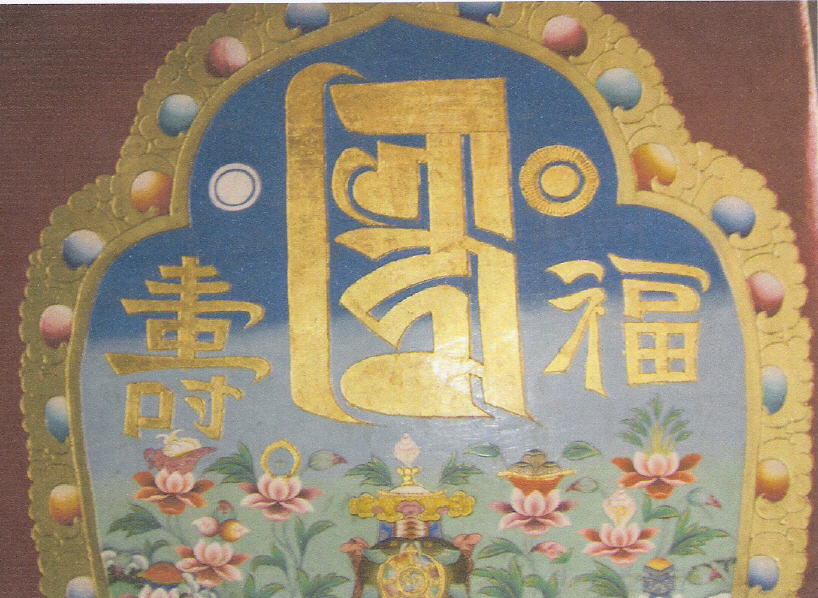
One also sees this written in Lantsa with a long ā and short i - i.e. लाक्ष्मि - this is common, though I think it is certainly an error. For example there is this image of the corrupt version with two hanzi: 壽 & 福 (Shòu & fú) literally 'life' and 'blessing'. More calligraphy of this version can be found on the East Wind Gallery site.

One sees the problem of mixed up vowel lengths a lot in Chinese and Japanese Siddhaṃ - for example the bīja dhīḥ is routinely written as dhiḥ (with a short i) in Japan. John Stevens says, in regard to other spelling errors that: "rightly or wrongly they have become part of the tradition." (Sacred Calligraphy, p.33). Personally I'm inclined to correct them as I say here and here.

For another (and much better) image of Lakṣmī's bīja written correctly see George Fisher's Indian Scripts website (the link is to a pdf, scroll down, Lakṣmī is the last bīja). The main website is www.lantsha-vartu.org.

22 May 2011

Yig mgo and shad

I noticed this image on Wikipedia this morning under Mongolian writing systems. I've straightened it, cropped it, and saturated the colours to highlight the text. The image combines a number of scripts and helps to illustrate something I've been researching for my book. There are two lines of vertical phags pa script at either end and five lines of horizontal text in the following scripts:
  1. Lantsa
  2. dbu can
  3. soyombo (A Mongolian script based on dbu can)
  4. dbu can
  5. Classical Mongolian
The top line reads : *|| la kṣiṃ ja nya su kha hī paṃ ||
The next line reads: **|| la kṣiṃ dza nya sukha hī paṃ ||

This is not a mantra I'm familiar with, but in any case I was mainly interested to draw attention the the marks I have transcribed as * and ||.


The sign transcribed by * I only know by its Tibetan name yig mgo pronounced 'yimgo'. It is followed by the vertical stroke । in Sanskrit is called daṇḍa 'rod, stick', and in Tibetan shad (pronounced shé), which here is doubled ॥ . In this case the Tibetan yig mgo combines both the standard yig gmo - - and the 'following' yig mgo - - to give ༄༅. This and even more ornate forms are often found at the head of texts. The Lantsa yig mgo adds what looks like the long ā diacritic which probably is the same idea.


The latter is simply the double daṇḍa or nyis shad in Tibetan. The daṇḍa is the only form of punctuation regularly used in Sanskrit. In poetry a single daṇḍa marks the end of a line, and a double daṇḍa marks the end of a stanza. In prose it is used more freely where in English we might use commas, semi-colons, dashes, colons, and full-stops.

I'm planning a longer article about these and similar marks for my blog in a couple of weeks, and have more detail in my forthcoming book.

18 October 2010

Rigpa Mantras

I'm a fan of the Rigpa Wiki website. I've just found that they have quite a few mantras, with some of them written out in dbu-can script. Overall I find it a handy reference for Tibetan iconography and have used it recently for the proper Tibetan spelling of names for Buddhas and Bodhisattvas.

27 September 2010

Hūṃ on bodhi leaf.


bodhi-hum
Originally uploaded by jayarava
I have been mucking about with a Chinese calligraphy brush lately. This is a hūṃ in the Tibetan dbu-can (Uchen) script. It is painted on a bodhi tree leaf, from my own bodhi tree which I grew from a seed collected in Bodhgaya under The Bodhi Tree.

05 July 2010

The Master at Work

Tashi Mannox has just posted another YouTube video of himself doing some calligraphy of the letters ཡག་གཟུགས་དམ་པ - yag gzugsa dma pa meaning 'sacred calligraphy'. It's great to be able to watch a really skilled calligrapher at work.


Sacred calligraphy in Sanskrit would be āryakalyāṇalekhā (आर्यकल्याणलेखा) - ārya 'noble, sacred'; kalyāṇa 'beautiful, excellent, noble, auspicious' is cognate with the Greek καλλι (calli-) 'beautiful'; and writing is lekhā, from √likh 'to scratch'.

25 February 2010

Tibetan Cymbal Symbols

A friend recently wrote to me:
Please could you tell me what my cymbals say?

I've been taking these cymbals into prison for over 15 years, to ding meditation stages. Occasionally, someone asks me what the symbols mean. I confidently reply that it is the Avalokiteshvara mantra.

Only, last week a bright spark asked if it says "om mani padme hum" how come there are seven symbols rather than six?
The answer is quite simple. It is the Avalokiteśvara mantra written in a Tibetan script called dbu-can (pronounced uchen) - the main formal script they use for texts and printing. The extra symbol is a paragraph marker, known as a 'shed' in Tibetan. It's more often a simple vertical stroke, but sometimes a colon-like thing as you have here.

oṃ ma ṇi pad me hūṃ :

I've added the letters onto your image so you can see which is which. While we're on the subject there is no word break in maṇipadme - it is a single compound word meaning, most likely "in the jewelled lotus" (but clearly not "the jewel in the lotus" as Sanskrit grammar does not allow this meaning, despite it's popularity). I've written about this on my blog post "The Meaning of oṃ maṇipadme hūṃ".

Note the Tibetans write "pa dme" as "pad me" because it looks more Tibetan. In the image below the top line is what is on your bells, and the bottom line is the proper Sanskrit, but still using the same script.


One also sees the mantra on these kinds of bells written in the Lantsa script (below).


My compliments to the bright spark who spotted that there were seven symbols!