The use of capital letters for mantras is puzzling a times. Take the mantra oṃ maṇipadme hūṃ. It's not uncommon to see this written Om Mani Padme Hum, or Even Om Ma Ni Pa Dme Hum etc. Wikipedia is full of this kind of idiosyncratic capitalisation and very resistant to change! Scholars often resort to all-caps: OM MANIPADME HUM. (Note that maṇipadme is one word, not two.)
No Indic script, including Tibetan as far as I know, has capital letters. They just write the sounds, though of course Tibetan includes a number of decorative characters but these are often used to mark the beginning of sentences or texts as a whole and aren't specific to mantras. But let me concentrate on what I know well which is Indic.
Capitals are supposed to be used for proper nouns, for the beginning of a sentence, and for the words in the title of a publication. But of course they are also, less conventionally, used for emphasis in things like advertising slogans and newspaper headlines. All-caps are OK though they don't look so good with Diacritics, and with longer mantras are difficult to read. In this age of email and SMS they appear to SHOUT! Capitalising every word looks a bit vulgar to me, like a slogan. Capitalising every syllable is ridiculous. Some of habits of capitalising religious words date back to the King James authorised version of the Bible which capitalises anything to do with God "In the beginning was the Word, and the Word was with God, and the Word was God." (John 1.1). It's almost as though by using capitals we are seeking to assert the special status of written mantras, an assertion that Indians felt no need to make. If we think a mantra is special then it is only piety to insist on it, and makes us look insecure in our belief. Capitals add nothing to the mantra really - after all the mantra is in the sounds, not the letters themselves, especially not the Roman script letters.
Over many years of contemplating mantras, especially in their written forms I've come to the conclusion that what marks the mantra out is usually the oṃ. Oṃ in Buddhism doesn't have the same kind of mystic symbolism as in Hinduism. Mainly what is says is "what follows is a mantra."
I've long just used lower-case for mantras, along with the academic convention of italics for foreign words. I think mantras are easier to read this way, and the diacritics are easy to see (for those who use them, and everyone should). It also seems a less strident, less ostentatiously pious, more confident way of writing mantras. On the whole we know the significance of a mantra if we are writing it and there's no need for a song and dance routine. Of course there is room for calligraphy and for decorative writing, but if we are representing the sounds then I advocate just using standard English conventions for capitalisation.
The correct way to write the mantra is: oṃ maṇipadme hūṃ.

Buddhist calligraphy and epigraphy. Mantra, Dhāraṇī, Sūtra. Languages: Sanskrit, Pāli, Tibetan. Scripts: Siddhaṃ aka Bonji (梵字), Tibetan (dbu-can/Uchen), Ranjana/Lantsa, Devanāgarī.
Showing posts with label mantras. Show all posts
Showing posts with label mantras. Show all posts
28 November 2010

18 October 2010
Rigpa Mantras
 I'm a fan of the Rigpa Wiki website. I've just found that they have quite a few mantras, with some of them written out in dbu-can script. Overall I find it a handy reference for Tibetan iconography and have used it recently for the proper Tibetan spelling of names for Buddhas and Bodhisattvas.
15 September 2010
Cundi
 Stumbled on an excellent webpage for the Cundi mantra today while answering a question for the Omniglot blog. Lots of background info and links to other info.
Cundi is a form of Avalokiteśvara. The Cundi site thinks she may be a Buddhist form of the goddess Caṇḍī, a non-vedic tribal goddess from Bengal. There are other non-vedic goddesses as well particularly (Pāli) Siri, (Sanskrit) Śrī, who becomes Lakṣmī - a goddess of luck.
13 November 2009
Tadyathā in the Heart Sūtra

tadyathā
http://jayarava.blogspot.com/2009/10/tadyatha-in-heart-sutra.html
08 February 2009
A couple of stray mantras
Of the thirteen principle Buddhas and Bodhisattvas of the Shingon school I have pages for eleven. The two that are missing are Mahāsthāmaprāpta and Samantabhadra, neither of whom have the same popularity (at least in these forms) in the West as they do in Japan. In some schools of Tibetan Buddhism Samantabhadra becomes the Adibuddha, that is he takes Mahāvairocana's role.
In anycase until I get around to creating pages for these two, here are their mantras in siddhaṃ with Roman, Devanāgarī, and, as an experiment, Tibetan (note the Tibetan is Unicode but you might need to find a Tibetan font as the Tibetan range isn't often included in standard fonts. I use Tibetan Machine Uni)
Mahāsthāmaprāpta (Seishi Bosatsu) महास्थामप्राप्त

oṃ saṃ jaṃ jaṃ saḥ svāhā
ओं सं जं जं सः स्वाहा
ཨོཾ་སཾ་ཇཾ་ཇཾ་སཿ་སྭཱ༌ཧཱ།
Note: Her bīja is saḥ सः སཿ
Samantabhadra (Fugen Bosatsu) समन्तभद्र

oṃ sa ma ya stvaṃ i.e. oṃ samayas tvaṃ
ओं समयस्त्वं
ཨོཾ་ས་མ་ཡ་སྠྭཾ།
Note:
samaya is an agreement or contract, the nominative singular is samayaḥ which changes to samayas when followed by the t of tvaṃ meaning you, also nom. sg. So that part means "you are bound", or "there is an agreement or contract with you". It probably refers to the tantric vows one takes before abhiṣeka.
Samantabhadra's bīja is aṃ अं ཨཾ
Do let me know how the Tibetan looks as I want to start using it more extensively.
In anycase until I get around to creating pages for these two, here are their mantras in siddhaṃ with Roman, Devanāgarī, and, as an experiment, Tibetan (note the Tibetan is Unicode but you might need to find a Tibetan font as the Tibetan range isn't often included in standard fonts. I use Tibetan Machine Uni)
Mahāsthāmaprāpta (Seishi Bosatsu) महास्थामप्राप्त
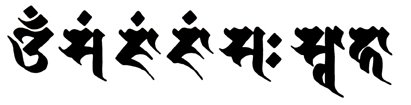
oṃ saṃ jaṃ jaṃ saḥ svāhā
ओं सं जं जं सः स्वाहा
ཨོཾ་སཾ་ཇཾ་ཇཾ་སཿ་སྭཱ༌ཧཱ།
Note: Her bīja is saḥ सः སཿ
Samantabhadra (Fugen Bosatsu) समन्तभद्र
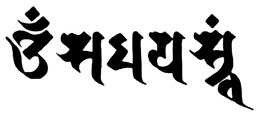
oṃ sa ma ya stvaṃ i.e. oṃ samayas tvaṃ
ओं समयस्त्वं
ཨོཾ་ས་མ་ཡ་སྠྭཾ།
Note:
samaya is an agreement or contract, the nominative singular is samayaḥ which changes to samayas when followed by the t of tvaṃ meaning you, also nom. sg. So that part means "you are bound", or "there is an agreement or contract with you". It probably refers to the tantric vows one takes before abhiṣeka.
Samantabhadra's bīja is aṃ अं ཨཾ
Do let me know how the Tibetan looks as I want to start using it more extensively.
Subscribe to:
Posts (Atom)