Showing posts with label Mysteries. Show all posts

07 January 2011

Giku

Recently Tracie wrote in:

I have a piece of calligraphy that I purchased 20 years ago at the monastery on Mt. Koya in Japan when I was an exchange student. At the time I just thought it was interesting but didn't look into its meaning.
Recently I was going through my things at my parents home and came across this piece of artwork again, I would like to know more about this character. The Japanese accompanying it says the pronunciation is Giku.
I can identify the character as gīḥ which fits with the Japanese pronunciation Giku, but I cannot find any more information about this syllable. I asked for help and my friend Maitiu replied:

In the East Asian tantric tradition at least the syllable gīḥ seems to be the bījā in mantras to the inner offering goddess Vajragītā [song of the thunderbolt]. I found Siddhaṃ mantras in two texts in the Taisho, T.867 and T.875.

T.867
金剛峯樓閣一切瑜伽瑜祇經
The Sūtra on all the Yogas and Yogins of the Vajra Peak Pavilion
唐南天竺國三藏沙門金剛智譯
Attributed to Vajrabodhi but it seems to be a compilation of ritual material rather than a translation of an Indian text.

一切如來內護摩金剛軌儀品第十
Chapter 10 – The Vajra Rite of the Internal Homa of All the Tathāgatas
[0266b18]
oṃ va jra gī te a gni
唵(引)  嚩 日囉 (二合)  儗  帝 阿 儗 儞(二合)
huṃ gīḥ
吽 儗(入聲)
[0266b18]

T.875
蓮華部心念誦儀軌
The Recitation Rite of the Heart of the Lotus Section
[0324b09] 內口供養。
The [four] Inner Offering [Goddesses]:
[0324b10] oṃ va jra lā sa haḥ  oṃ va jra ma la traṭ
[0324b11] oṃ va jra gī te gīḥ  oṃ va jra dṛ tye kṛ ṭ [this should be varjanṛtye kṛṭ]
[0324b09] 內口供養。

In the 16th section of the Sarvatathāgata-tattvasaṃgraha gīḥ occurs in a slightly different context but still connected with the word gītā.

STTS - ṣoḍaśamaḥ
Padmaguhyamudrāmaṇḍalavidhivistaraḥ
athāsāṁ mudrā bhavanti|
oṁ padmaratipūje hoḥ||
oṁ padmābhiṣekapūje raṭ||
oṁ padmagītapūje gīḥ||
oṁ padmanṛtyapūje kṛṭ||
oṁ dhūpapadmini huṁ||
oṁ padmapuṣpi hūṁ||
oṁ padmakulasundari dharmāloke pūjaya hūṁ||
oṁ padmagandhe hūṁ||

24 June 2009

Sword with Fudō Bīja and a mystery

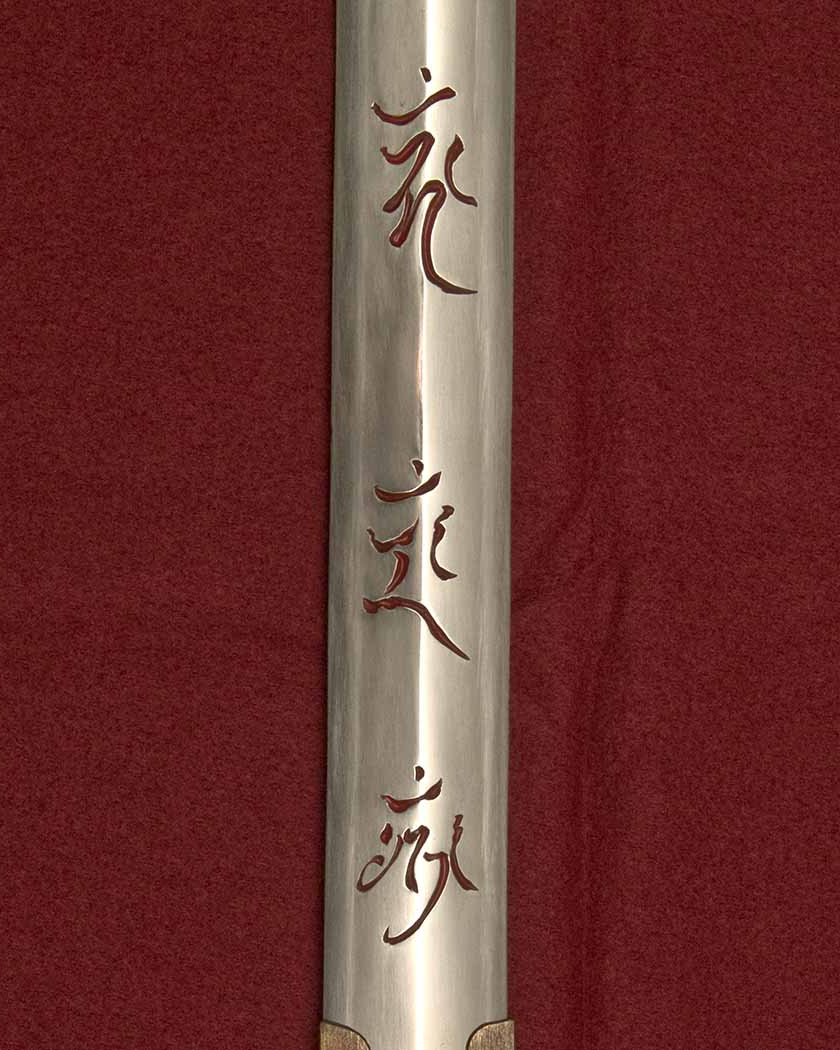
Sword with Siddhaṃ characters - hāṃ, maṃ, āṃḥ (?)Richard sent me this pic of a Japanese sword asking if the symbols are Siddhaṃ. They are, but there is a bit of a mystery. The top two symbols are hāṃ and maṃ which are both associated with Fudō Myōō.

The bottom syllable looks like Siddhaṃ as well but it is so stylised that I can't read it. Taking a guess I think it might be some variation on 'a' because that would fit what I know about Fudō and his association with Mahāvairocana of whom the 'a' is the bīja. My guess is that it is āṃḥ - the elaborate variation that includes a, ā, aṃ, and aḥ symbolising the four stages of the spiritual path in the Mahāvairocana Abhisaṃbodhi Tantra.

If you know for sure what it is please let me know and I'll pass it on. The original photo is here.

08 September 2008

Mystery Mantra

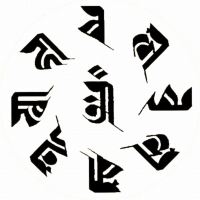
A couple of days ago I noticed a mystery mantra on Omniglot's Puzzles Page. I couldn't see well enough to read so wrote and asked Mitchell who'd posted it to send a better quality image. He sent me the image on the left and things became more clear.

The script is obviously Lantsa. I know some Lantsa and there are one or two Lantsa resources on the web (see the scripts page) but I'm not very confident in it yet.

The centre syllable is obviously oṃ. From 12 o'clock I read ca le cu le co nde svā hā.

So the mantra is: oṃ cale cuale conde svāhā.

However this is not a mantra I am familiar with, nor can I find it in any of my usual sources. If you know this mantra please let me know.

Update: 18-9-08 and 3-11-08

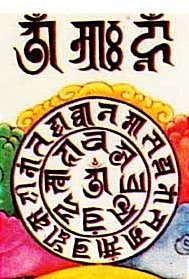
Thanks to Fuxi who wrote in to suggest that this mantra may be related to Zhunti. If you look at Mediation Expert you can see the same diagram on a page of the sadhana instruction. In Sanskrit the name is Cundī, meaning "pure" and she is a feminine form of Avalokiteśvara, or perhaps a form of Uṣas or Mārīcī. In the Mahācundi Dhāraṇī there is a mantra: namo saptanam samyaksambuddha kotinam tadyatha: oṃ cale cule cundi svaha. The mantra above could be a form of this.

If you look at the image on the left, which is a close-up of a Cundi image, you can see some Sinified Lantsa script.

Across the top in larger letters is: oṃ āḥ hūṃ

Around the outer circle of the image reads: namo saptanam samyaksambuddha kotinam tadyatha. It starts just to the right of 12 o'clock.

The centre of the circle matches the image originally sent to Omniglot by Mitchell, with oṃ at the very centre. Ca is distinguished by a point on the loop - so with some hindsight we can see that the character could be ca. On the 3rd character what I took to be an 'r' ligature could be a 'u' diacritic though this usually is more curved and doesn't terminate on the stem. So the mantra above should be read:
oṃ cale cule cunde svāhā.