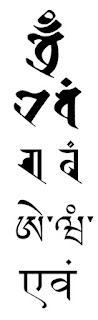
Last year Tashi Mannox featured the word
evaṃ on his
calligraphy blog. His calligraphy is always attractive and adept, but I was fascinated by this particular character. Buddhists will know that one of the identifying marks of a
sutta/sūtra is that it begins:
evaṃ me sutaṃ/evaṃ mayā śrutaṃ. Tantras also begin with this phrase. The word
evaṃ means 'so, thus, in this way'. The phrase is a passive construction, literally "thus / by me / it was heard", and attempts by contemporary scholars to override the Victorian rendering "thus have I heard" have not yet succeeded in dislodging it from the English speaking Buddhist psyche.

However in the Hevajra Tantra (ca. late 8th century) this first word takes on esoteric significance. I think this is largely related to the shape of the Siddhaṃ script letter 'e' which is an inverted triangle which in the Hevajra becomes a yoni symbol - i.e. because it looks like the female pudenda it represents the feminine principle. To my eye vaṃ is not particularly phallic, but it comes to represent the masculine principle. Perhaps the most significant correspondence is that of wisdom and compassion. So evaṃ, by combining the two principles, symbolises the union of opposites which is one of the ways in which the Buddhist goal is conceived of in Tantric Buddhism. This is my understanding, though Tashi has more information on his website.
For some time I have pondered how to represent this in the Siddhaṃ script, and I think I have finally found a way of doing it which is aesthetically pleasing.
image top-left: from the top - evaṃ bīja; evaṃ in Siddhaṃ, Lantsa, Tibetan, Devanāgarī.
image right: evaṃ bīja


