07 December 2009

Stryi and the Karaṇḍamudrā Dhāraṇī

Back in Feb 2009 I was intrigued by a complex seed-syllable seen carved on the side of a Japanese stūpa. I could see the Siddhaṃ elements but wanted to understand the context. Eventually, with a little luck, I managed to identify the bīja as stryi which is associated with an important Japanese liturgical text: the Karaṇḍamudrā Dhāraṇī. I put some notes into this blog, but have now put this material on its own page: Karaṇḍamudrā Dhāraṇī and stryi.

At some point I want to do some Siddhaṃ calligraphy of the dhāraṇī itself, but here at least you can see where the syllable stryi originates from.

Some other versions of stryi can be seen in this Flickr Gallery: Stone Siddhaṃ.

13 November 2009

oṃ

The 'om' seed syllable in Siddham script

Seed-syllable oṃ
in Siddhaṃ

I upgraded the oṃ page.

I don't whether to be pleased that my calligraphy and other methods have improved, or horrified at how poor some of my earlier work was. Hopefully the whole site will gradually be brought up to a higher level.

Tadyathā in the Heart Sūtra


tadyathā
My Jayarava's Rave blog post today is about tadyathā especially in relation to the Heart Sutra mantra.

http://jayarava.blogspot.com/2009/10/tadyatha-in-heart-sutra.html

12 November 2009

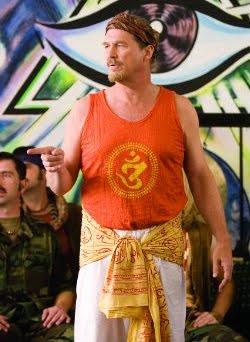
Men who stare at calligraphy

In the movie The Men Who Stare at Goats Jeff Bridges character is twice seen wearing a singlet with a large Siddhaṃ oṃ on it - see left.

See also my version of oṃ on Flickr.

08 November 2009

Mystery Amulet

Nigel sent in this image of his amulet and asked about the mantra on it. The mantra is in the Tibetan Uchen (dbu-can) script. In the centre is the seed-syllable (bījākṣara) oṃ. The mantra starts at 6 c'clock and goes clockwise. It reads
oṃ sarvatathāgatoṣṇīṣasitātapatre hūṃ phaṭ hūṃ mama hūṃ ni svāhā
If we break the sandhi and add dashes for compounds it reads:
oṃ sarva-tathāgataḥ
uṣṇīṣa-sita-ātapatre hūṃ phaṭ hūṃ mama hūṃ ni svāhā


So now it becomes clear that this is a mantra for Uṣṇīṣa-sitātapatra (also spelt Uṣṇīṣa-sitātapattra) a Tantric goddess with 1000 heads, 1000 arms, and 1000 legs! Her name means something like 'crowned with a white parasol'. Her iconography is very complex, though apart from her multiple limbs she does carry a white (sita) umbrella/parasol (ātapatra) or sometimes a Tibetan victory banner. Robert Thurman tells us that she is a special form of Tārā and a counter part to the 100o armed form of Avalokiteśvara (The Sacred Art of Tibet p.319-321).

Here's the mantra written out in dbu-can.
Uṣṇiṣa-sitā-tapatra mantra

Try here for an image of Uṣṇīṣa-sitātapatra.
Nigel made a generous donation for receiving this information - thanks again!

07 November 2009

YouTube

Just found a new cache of Siddhaṃ calligraphy on YouTube (thanks to Riccardo's Facebook page Bonji 梵字 - Riccardo is a bit naughty and has been taking images from here without asking, but I'm sure we can sort something out). These are quite interesting examples which from the accompanying text and commentary are from Japan.

The Fudō Bīja hāmmāṃ


The Mahāvairocana Seed Syllable vāṃḥ


Note here that the calligrapher makes an error. He writes ba instead of va. The two are very similar. In ba the curve curls back to meet the stem on the up-stroke, whereas on the va it continues down to the stem on the down-stroke. These letters are similar in most Indic scripts: cf Devanāgarī ब व. Indeed they are often confused in pronunciation as well.

03 November 2009

Arapacana Monogram


Arapacana Monogram
Originally uploaded by jayarava
I was asked about doing a Kalacakra style monogram by someone and so have been playing around. Arapacana seemed the obvious choice to do. Seeing all those tails hanging down it seemed like a good idea to braid them.

I quite like the result and may do more - though it's quite painstaking getting it to fit.

30 October 2009

The Hundred Syllable Vajrasattva Mantra

100 syllable Vajrasattva Mantra in SiddhamMy latest post on Jayarava's Raves is some notes on a translation of the 100 Syllable Vajrasattva Mantra. I also offer some commentary on the words, though I plan to write a longer piece on this. I've also replaced the translation on the Visible Mantra Vajrasattva page.

I worked on this for my book project (still lumbering on) but couldn't wait to share it. The version of the mantra I'm commenting on is the one in the FWBO Puja Book.

On the 12th of Dec I'm running a workshop at the Cambridge Buddhist Centre where we will study the Sanskrit text and then chant the mantra. Book online by visiting the CBC Website.

Happy Halloween - the Vajrasattva mantra is just what you need to keep the ghouls and ghosts away!

oṃ vajrasattvasamayamanupālaya vajrasattvatvenopatiṣṭha dṛḍho me bhava sutoṣyo me bhava supoṣyo me bhava anurakto me bhava sarva siddhiṃ me prayaccha sarvakarmasu ca me cittaṃ śreyaḥ kuru hūṃ ha ha ha ha hoḥ bhagavan sarvatathāgatavajra mā me muñca vajrī bhava mahāsamayasattva āḥ

27 October 2009

Unwise Tattoo?


Wisdom
Originally uploaded by Jaspreet Dhillon
Saw this on Flickr. The word for wisdom is prajñā - a feminine noun in -ā.

This person has: प्रज्ञाः prajñāḥ

Prajñāḥ is the nominative plural: wisdoms. Whoops.

10 October 2009

Karanīya Mettā Sutta


Karanīya Mettā Sutta
Originally uploaded by jayarava
This is the well known Karanīya Mettā Sutta from the Suttanipāta (Sn 143-152). More info on my Flickr Site - click the image to find it.

I offer this version to offset the unskilful things I've done, said and thought in the last couple of weeks. Please feel free to copy this and spread it around.

My website has the Roman text and my translation. I've done another more colloquial translation. Also I've done a partial commentary. There are many translations online, each with its own merits.


14.6.10
I've not also translated an exert from the commentary to the Karanīya Mettā Sutta which explains the circumstances in which the Buddha gave the discourse: How the Karanīya Mettā Sutta Came About.