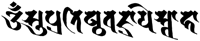
Caught up with Tashi Mannox on a recent visit to London which was cool. He gave me a calligraphy of a mantra I hadn't come across before. It is used in the conclusion of Tibetan sadhanas.
So after doing some research and consulting him about the Tibetan writing and pronunciation I've added the first new page to visiblemantra.org for some time. I'm calling it the supratiṣṭha mantra for want of a better name. The page has Siddhaṃ, Uchen and Devanāgarī.
31 August 2009
25 June 2009
Tattoos
Every now and then I get a fun request for a tattoo and this mornings effort is a gem of the genre.
I'll start the bidding with: बष्वुल्, डक्, डौपी, ग्रंपी, हप्पी, स्लीपी, स्नीसी
"I was wondering if you guys could translate the Seven Deadly sins and the Seven Holy Virtues into Buddhist Sanskrit for me. I want to tattoo it on my back."Given that he won't be able to read the result - what would you write on his back? Must be in lots of seven!
I'll start the bidding with: बष्वुल्, डक्, डौपी, ग्रंपी, हप्पी, स्लीपी, स्नीसी
24 June 2009
Sword with Fudō Bīja and a mystery
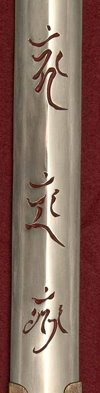
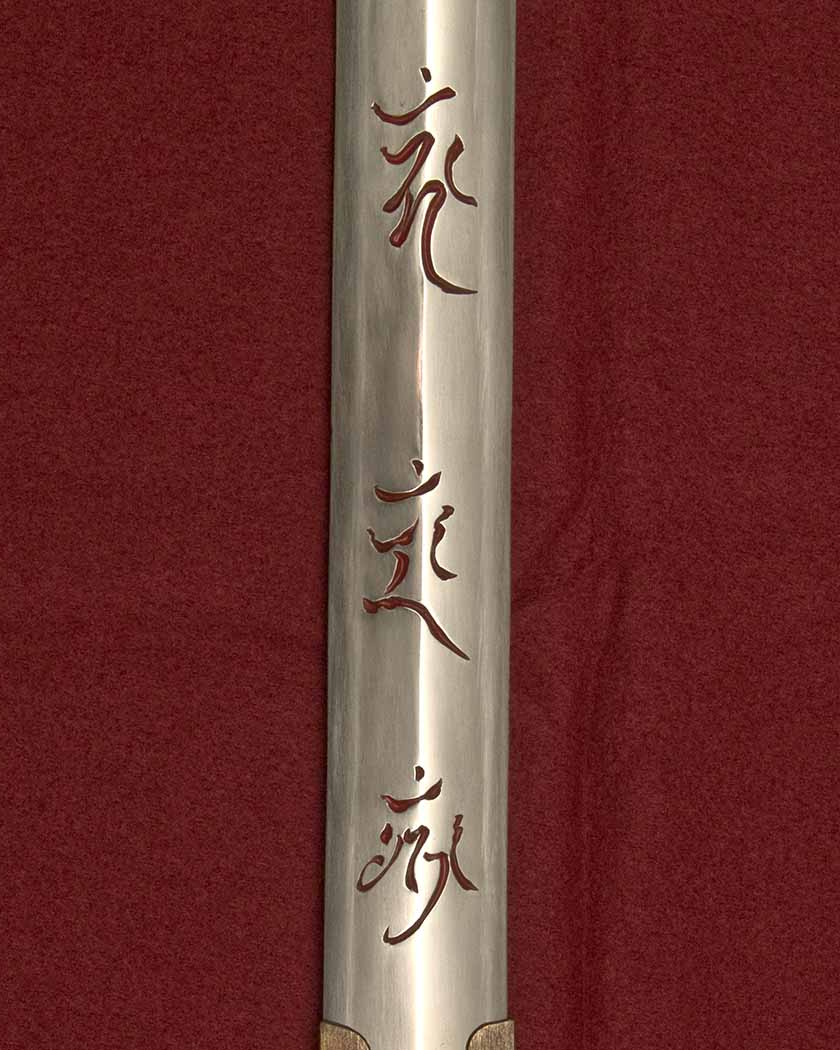
The bottom syllable looks like Siddhaṃ as well but it is so stylised that I can't read it. Taking a guess I think it might be some variation on 'a' because that would fit what I know about Fudō and his association with Mahāvairocana of whom the 'a' is the bīja. My guess is that it is āṃḥ - the elaborate variation that includes a, ā, aṃ, and aḥ symbolising the four stages of the spiritual path in the Mahāvairocana Abhisaṃbodhi Tantra.
If you know for sure what it is please let me know and I'll pass it on. The original photo is here.
Labels:
Mysteries
16 June 2009
aṃ
This is simply a variety Siddhaṃ. It looks like it was either done with a Chinese Calligraphy brush or is designed to look that way. Note that even contemporary Siddhaṃ calligraphy can vary quite widely in style.
01 June 2009
Readers' Work
This is a stunning setting for the mantra and an interesting combination of East and West. As I wrote to Seishin - the cool blue of the hāṃ amidst the hot yellow and red flames invokes one of the fundamental Buddhist metaphors: the coolness of nirvāṇa
I'm more than happy to see, and to showcase other people's work if anyone wants to send any in.
Labels:
Readers Work
21 May 2009
Onmyoji 3 & 4
The mantras in the comic are used by tantric wizards, often to subdue demons. So if you read French and like mangas check it out.
Sometime back on this blog I asked for info about some obscure mantras but never heard anything. In Onmyoji 3 the Fudo mantra is featured - which is what made me create a Fudo page for visiblemantra.org.
Labels:
Onmyoji,
publications,
updates
22 April 2009
wheel-of-letters
Someone asked me what the wheel of Sanskrit letters sometimes found in Buddhist visualisations practices would look like. So here's something I knocked up with Word using Devanāgarī.
The inner circle is the vowels, middle is the consonants (including kṣa) and the outer circle is the famous phrase: ye dharmā hetuprabhava hetuṃ teṣaṃ tathāgataḥ hyavadat, teṣaṃ ca yo nirodha - evaṃ vādī mahāśramaṇaḥ. The latter is often included in the visualisation practices. All start at 12 o'clock.
I think however that the vowels and consonants should be going in different directions - so this is just to give you an idea and is not definitive. I plan to do a definitive version in Siddhaṃ at some point.
16 April 2009
Updates
I've updated the calligraphy for Vajrasattva and the Heart Sūtra. Also updated the notes on the Heart Sūtra and linked to my synopsis of Jan Nattier's article on where the sūtra was composed (China rather than India almost certainly). I added the Uchen script the Śuddha mantra (aka the Śunyata Mantra) - using an image of the font Tibetan Machine Uni which I have resorted to instead of calligraphy.
13 April 2009
Tashi Mannox
I note that Tashi Mannox now has a blog which goes into some of the background to his very excellent Tibetan calligraphy. The address is inkessential.blogspot.com. Some very interesting material there already!
10 April 2009
White Tārā
I've recently updated the notes on the White Tārā mantra in accordance with a new understanding of Sanskrit. Not all ambiguities are able to be resolved, but at least it is now clear what is ambiguous and in what way. I've changed the way I present the variations on the mantra. My previous efforts were too dependent on books, and have again benefited from my Sanskrit studies.
Much remains to be done in this vein, although it is important to recall that mantras are not entirely translatable and that this kind of approach is limited. The White Tārā mantra is somewhat unusual in containing grammatical sensible phrases.
Subscribe to:
Posts (Atom)